Manufacturing in Europe
.avif)
Gypsum-based construction products are Made-in-Europe.
The gypsum industry operates around 150 factories in Europe. We directly employ about 19,000 people. More than a million professionals install plasterboard around Europe. Gypsum products are manufactured close to the local markets, limiting the transport-related impacts.
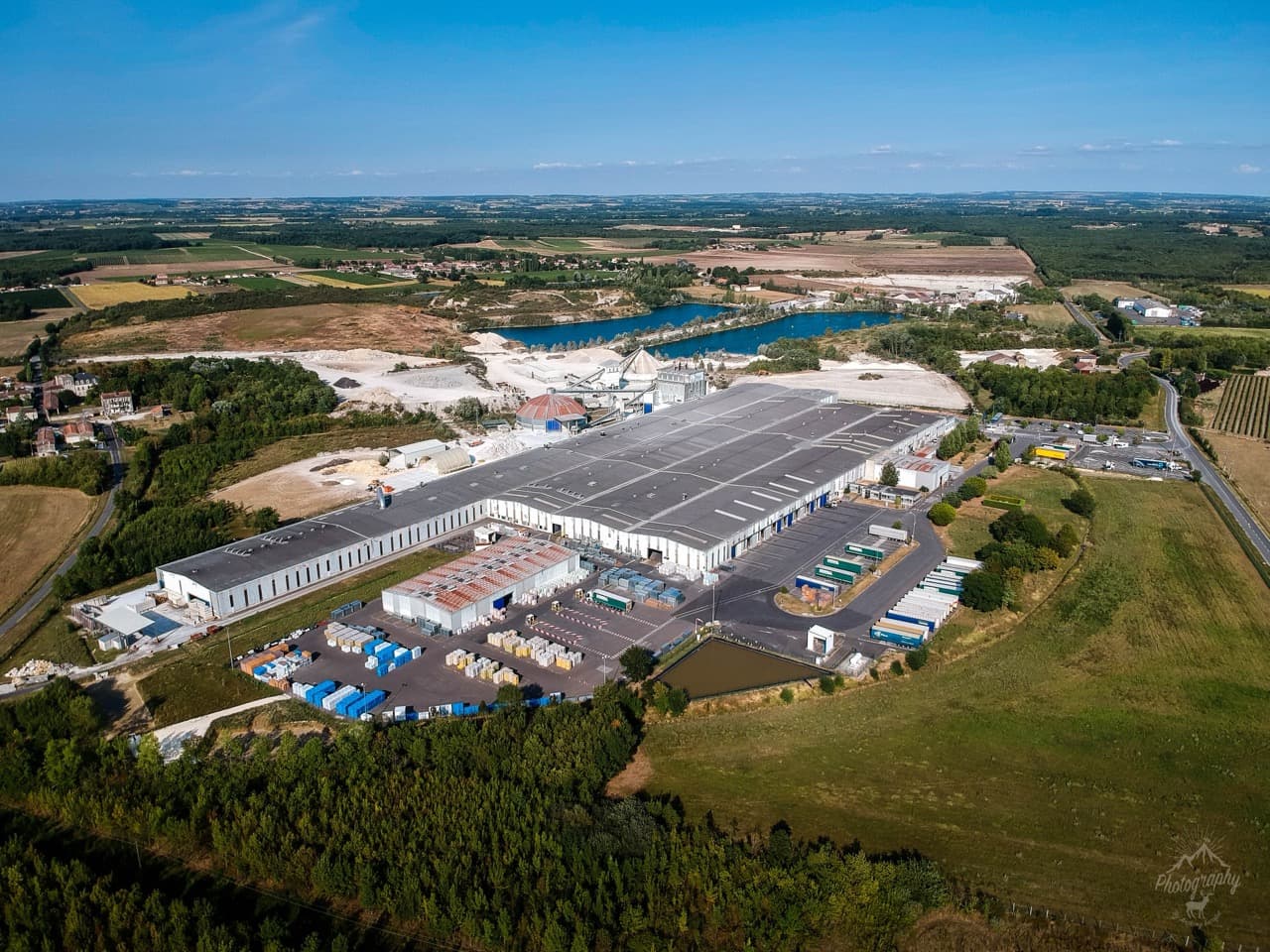
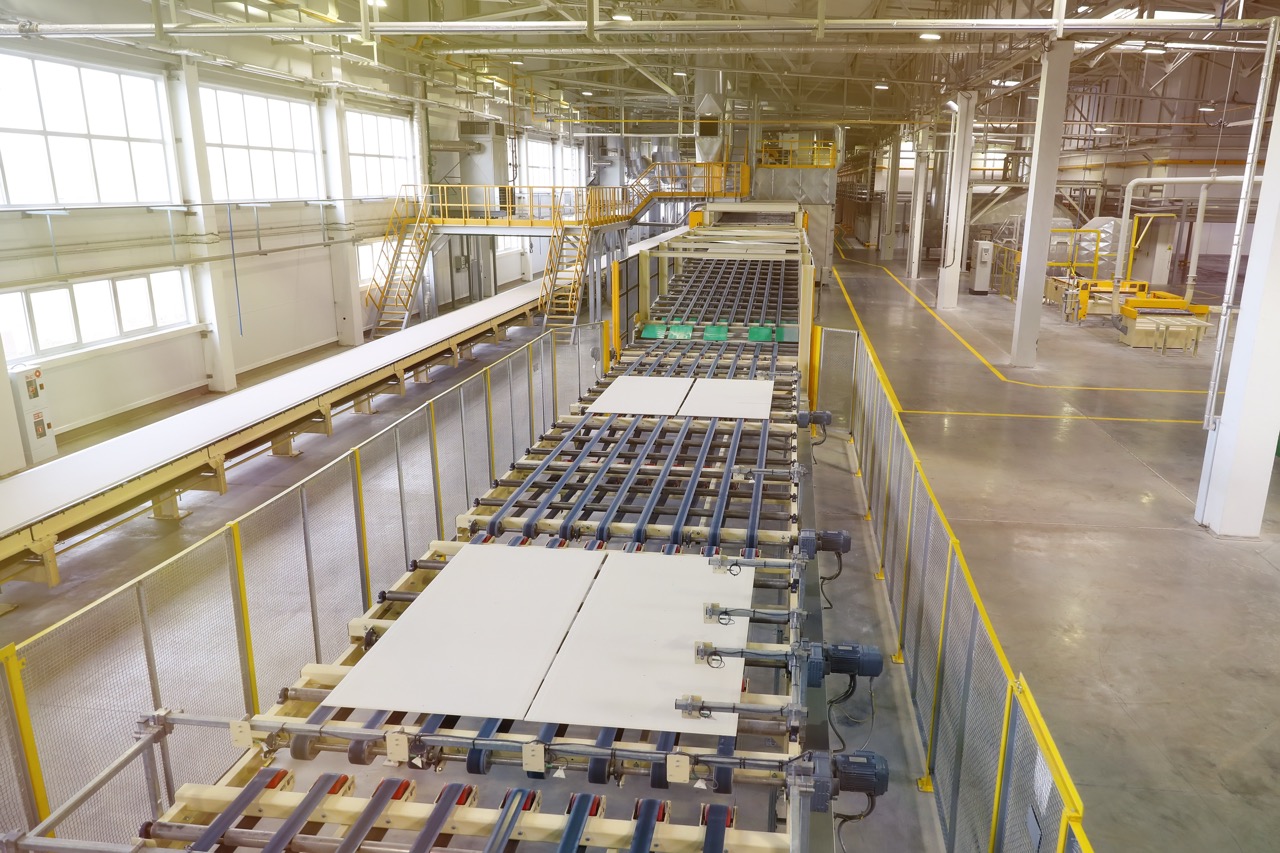
Saint-Gobain Placo® plasterboard manufacturing facility, Val-de-Cognac, France. © Saint-Gobain Placo®
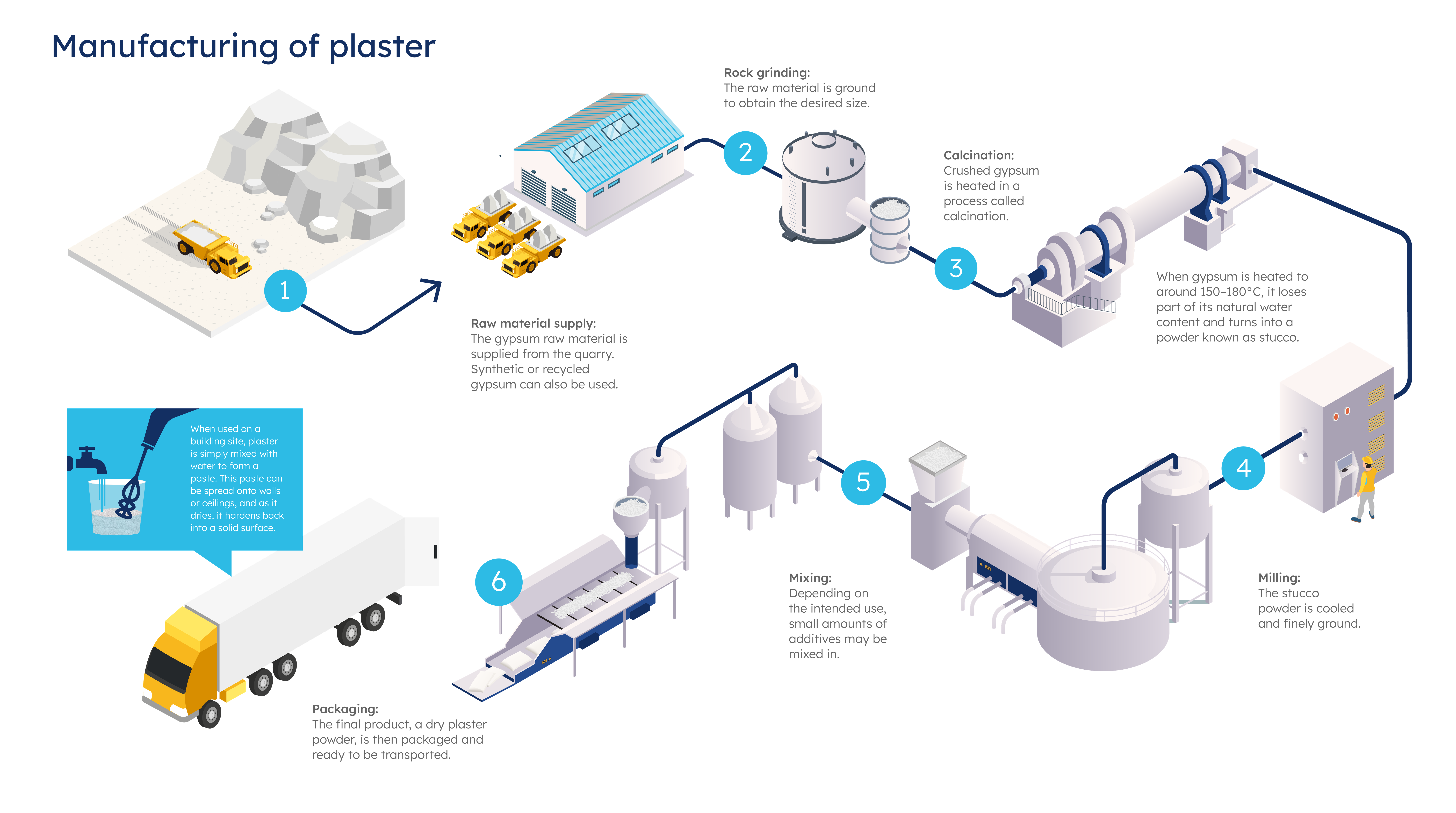
How is plaster made?
- Raw material supply: The gypsum raw material is supplied from the quarry. Synthetic or recycled gypsum can also be used.
- Washing and grinding: The raw material is washed and ground to obtain the desired size.
- Calcination: Crushed gypsum is heated in a process called calcination. When gypsum is heated to around 150–180°C, it loses part of its natural water content and turns into a powder known as stucco.
- Milling: The stucco powder is cooled and finely ground.
- Mixing: Depending on the intended use, small amounts of additives may be mixed in.
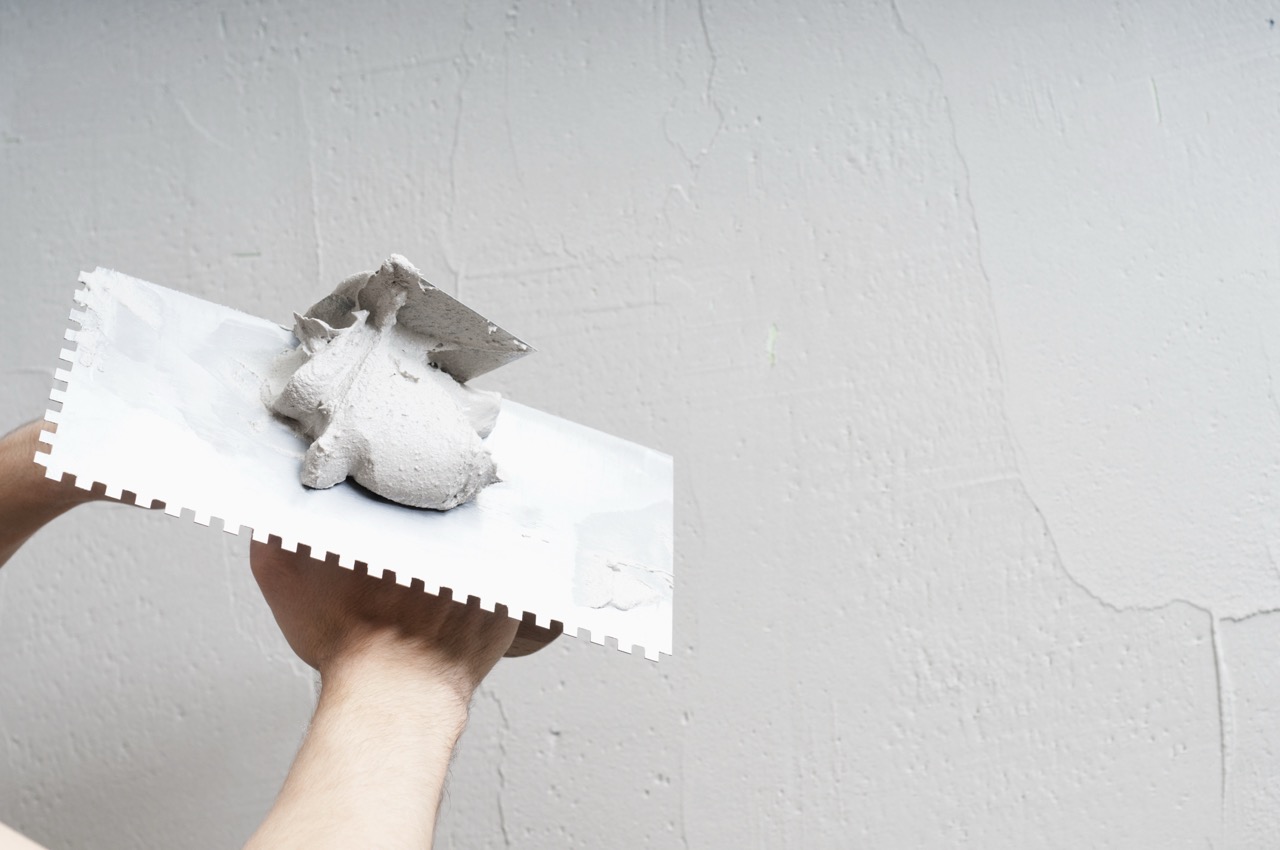
- Packaging: The final product - a dry plaster powder - is then packaged and ready to be transported. When used on a building site, plaster is simply mixed with water to form a paste. This paste can be spread onto walls or ceilings, and as it dries, it hardens back into a solid surface.
How is plasterboard made?
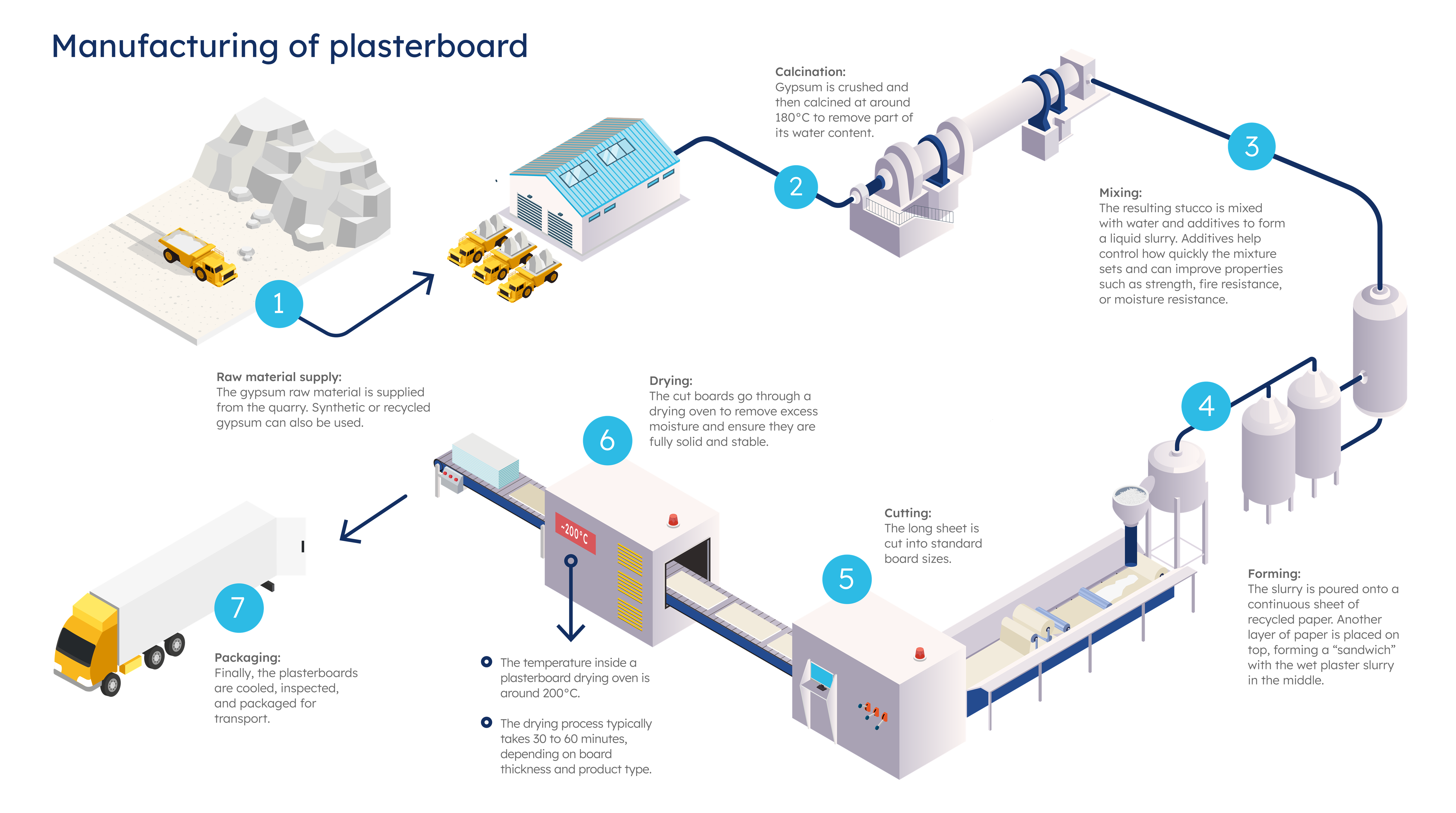
- Raw material supply: The gypsum raw material is supplied from the quarry. Synthetic or recycled gypsum can also be used
- Calcination: Gypsum is crushed and then calcined at around 180°C to remove part of its water content.
- Mixing: The resulting stucco is mixed with water and additives to form a liquid slurry. Additives help control how quickly the mixture sets and can improve properties such as strength, fire resistance, or moisture resistance.
- Forming: The slurry is poured onto a continuous sheet of recycled paper. Another layer of paper is placed on top, forming a “sandwich” with the wet plaster slurry in the middle.
- Cutting: The long sheet is cut into standard board sizes.
- Drying: The cut boards go through a drying oven to remove excess moisture and ensure they are fully solid and stable. The temperature inside a plasterboard drying oven is around 200°C. The drying process typically takes 30 to 60 minutes, depending on board thickness and product type.
- Packaging: Finally, the plasterboards are cooled, inspected, and packaged for transport.
How are gypsum blocks made?
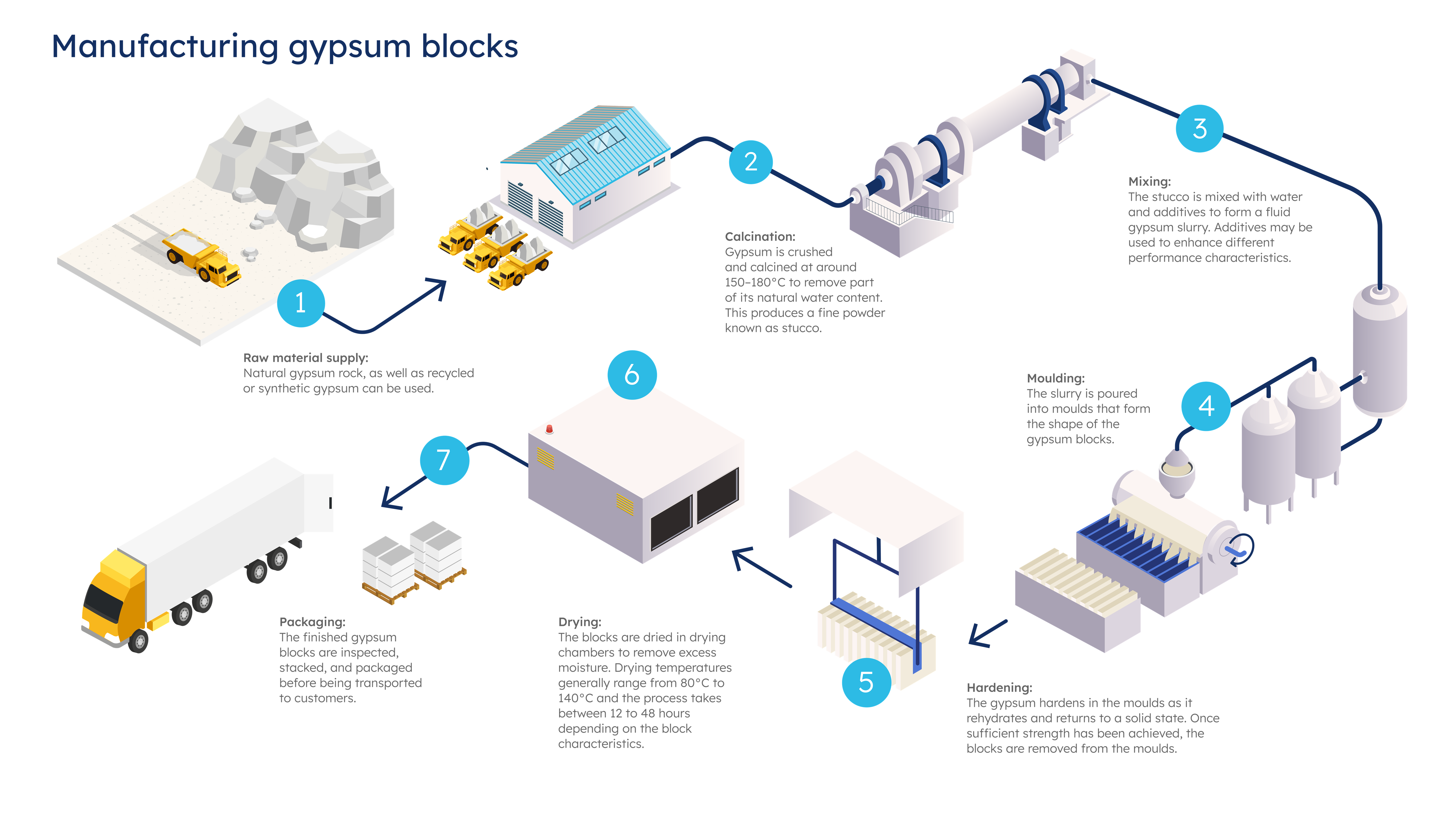
- Raw material supply: Natural gypsum rock, as well as recycled or synthetic gypsum can be used.
- Calcination: Gypsum is crushed and calcined at around 150–180°C to remove part of its natural water content. This produces a fine powder known as stucco.
- Mixing: The stucco is mixed with water and additives to form a fluid gypsum slurry. Depending on the intended application, additives may be used to control setting time, improve strength, reduce water absorption, or enhance other performance characteristics.
- Moulding: The slurry is poured into moulds that form the shape of the gypsum blocks, including any tongue-and-groove profiles or interlocking features required for assembly.
- Hardening: The gypsum hardens in the moulds as it rehydrates and returns to a solid state. Once sufficient strength has been achieved, the blocks are removed from the moulds. This setting process is largely driven by a natural chemical reaction and requires no additional heat generation.
- Drying: The blocks are dried in drying chambers to remove excess moisture and ensure dimensional stability. Drying temperatures generally range from 80°C to 140°C, depending on the block size, density, and production process. The drying process usually takes 12 to 48 hours, considerably longer than plasterboard drying because of the greater product thickness.
- Packaging: The finished gypsum blocks are inspected, stacked, and packaged before being transported to customers. The blocks are then ready for use in the construction of non-load-bearing partitions and other interior applications.
Contact person:

.jpg)